
The plan to abolish Test Valley Borough Council in 2028 was withdrawn on 7 September. What it would have done, and why May 2027 is now a borough election.
Update, 11 September 2026: The government withdrew this decision on 7 September 2026. Test Valley Borough Council is no longer due to be abolished on 1 April 2028, and the May 2027 election will be an ordinary borough election on existing boundaries. Read our report on the withdrawal. The article below describes the decision as it stood when we published it on 24 August 2026.
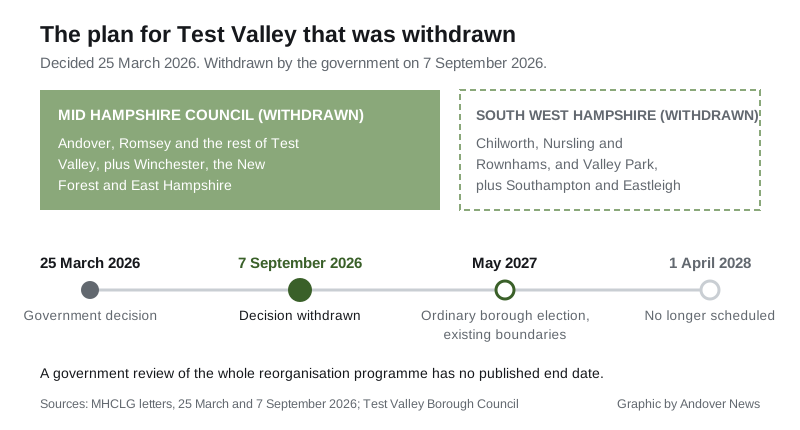
Under the March 2026 decision, Test Valley Borough Council was to stop existing on 1 April 2028, and so was Hampshire County Council. Andover, Romsey and most of the borough were to be run by a single new authority called Mid Hampshire Council.
Three parishes at the southern end of the borough were not to be part of it. They were to move into a different new council, built around Southampton and Eastleigh, against the borough council’s wishes.
Councillors on the borough’s overview and scrutiny committee were given the first of a planned series of reports on all this on Wednesday 19 August. It is worth reading what it says, because the timetable is now short. (Local Government Reorganisation report to Overview and Scrutiny, 19 August 2026)
What was decided, and by whom
The decision was made on 25 March 2026 by Steve Reed, the Secretary of State for Housing, Communities and Local Government, in a letter to council leaders across Hampshire, the Isle of Wight, Portsmouth and Southampton. (Decision letter, 25 March 2026)
At the moment most of Hampshire has two tiers: a district or borough council for things like bins, planning and housing, and the county council for roads, schools and social care. That ends. Four new all-purpose councils will cover the mainland, with the Isle of Wight staying as it is:
- Mid Hampshire Council: East Hampshire, New Forest, Test Valley and Winchester, minus 11 parishes.
- North Hampshire Council: Basingstoke and Deane, Hart and Rushmoor.
- South West Hampshire Council: Eastleigh, Southampton, four parishes from the New Forest and three from Test Valley.
- South East Hampshire Council: Fareham, Gosport, Havant and Portsmouth, plus three parishes from East Hampshire and one from Winchester.
Those numbers reconcile. The 11 parishes taken out of Mid Hampshire are the seven going to South West Hampshire and the four going to South East Hampshire.
Which parts of Test Valley are moving
The decision letter says three Test Valley parishes go to South West Hampshire Council. The borough council names the communities affected as Chilworth, Nursling, Rownhams and Valley Park. (Test Valley Borough Council, 25 March 2026)
That is four place names and three parishes because Nursling and Rownhams share a single parish council, as the borough’s own list of parish councils shows.
If you live in one of those places, your council from April 2028 will be South West Hampshire, not the same authority as Romsey a few miles up the road.
The council fought this bit and lost
Test Valley supported the four-council model from the start. It did not support the boundary change. The report to councillors on 19 August says so plainly: the council “did not support the boundary change element that has been approved by the Secretary of State”.
In March the borough’s chief executive, Andy Ferrier, put it this way:
“While it was not our preferred option as it means the parishes of Chilworth, Nursling, Rownhams and Valley Park will become part of a new South West council with Southampton, Eastleigh and the Waterside, it does result in the vast majority of Test Valley remaining intact.”
He added a detail that matters to anyone in the south of the borough who feared worse:
“It’s worth noting that by taking part in the process we were able to resist proposals from some councils to include Romsey, North Baddesley and Braishfield in the new South West unitary.”
He also said residents in the affected communities would “be deeply disappointed” and that their concerns “will not be ignored”.
When you actually get a vote
Nothing changes overnight, but the dates are fixed enough to plan around.
- May 2027: elections to the shadow councils. These are temporary authorities that plan and prepare the new council before it takes over. The Secretary of State’s letter is blunt about what this does to the normal cycle: “the elections that will take place for new authorities in 2027 will replace any existing local elections planned”.
- 1 April 2028: the new councils start. Existing borough, district, city and county councils are abolished on the same day.
Before any of that, Parliament has to approve a Structural Changes Order, the piece of legislation that formally abolishes the old councils and creates the new ones.
The August report does not pretend this is straightforward. It calls the Hampshire reorganisation “the most complex LGR that has occurred to date due to factors such as the population size, the number of councils involved and the inclusion of boundary changes”.
Money for the changeover is thin. The government is providing at least £900,000 per new unitary council, which the decision letter confirms means £3.6 million for the four new Hampshire mainland councils.
What the council says it is doing about it
The rest of the 19 August report is about the risk nobody votes on: that a council covering four current districts is too big to know its own patch. The report quotes the title of research the borough commissioned before the bid went in, “The bigger you go, the less you know”, and argues the new authorities will have to work at “human scale”.
Parish and town councils are expected to carry a lot of that. Mid Hampshire, the report notes, is “universally parished” with the exception of Winchester City, so parishes are likely to play a large part in whatever replaces the borough as the local layer. A requirement to set up neighbourhood governance is being placed on every council in England by the English Devolution and Community Empowerment Act.
The council has hired the think tank New Local for 12 months to test how that could work across five areas. Two are close to home:
- Town-based governance, with the first work being done in Romsey, where there is already a town council and an established community sector.
- Neighbourhood health, working with NHS partners in Andover on getting public services to collaborate at neighbourhood level.
The other three cover rural governance, community resilience and work with young people outside mainstream provision. The output is a report due by July 2027, three months after the shadow councils are elected.
The committee was asked only to “endorse the direction of travel”. Further reports are planned on:
- how residents are told about the change
- the future relationship between the new council and parish and town councils
- the new council as a housebuilder and manager of housing stock
- future models of service delivery
- what happens to the scrutiny function itself
What it means for you
Nothing changes about your bins, council tax bill or planning application. Test Valley Borough Council continues to run those services, with no end date now set.
Your next borough election is a borough election again. Under the March decision the May 2027 vote would have elected a shadow council. Since the withdrawal on 7 September 2026, the government says May 2027 elections “will go ahead to existing council boundaries”.
If you live in Chilworth, Nursling, Rownhams or Valley Park, the plan to move you to a South West Hampshire council has gone with the rest of the decision. You stay in Test Valley.
If you want to follow it properly, the papers are public. The full reports pack from 19 August, including the two commissioned research reports, is on the council’s website, and the committee has published a work programme of further LGR items.
One practical warning. A single planning authority covering Andover, Romsey, Winchester, the New Forest and East Hampshire will eventually decide applications that four separate councils decide now. The Local Plan work going on at Test Valley will still matter after 2028, because plans do not vanish when a council does. We cover new applications weekly on our Andover planning news page.
Have your say